Zara Hansen · 17 October 2026
Examining the Role of Version Control in Preserving Note Histories Within Digital Notebooks
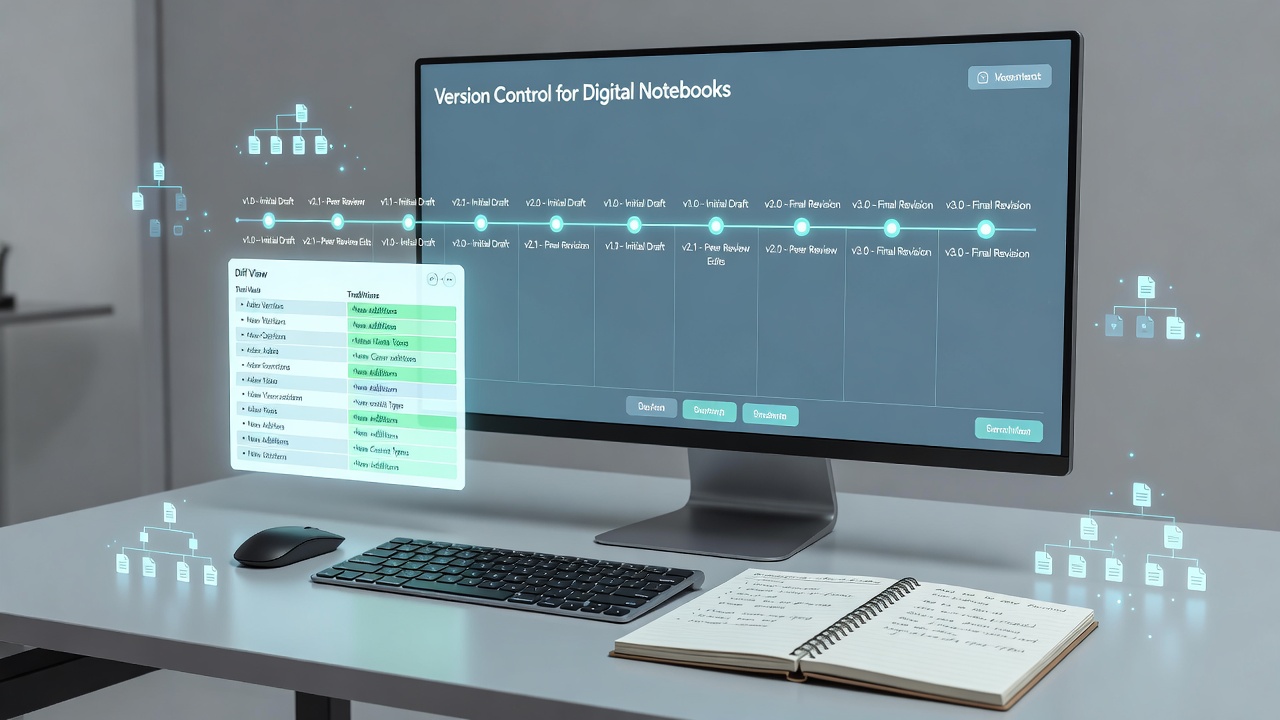
Version control systems track changes to digital notes over time, allowing users to access previous versions and maintain complete records of edits in notebook applications. These mechanisms operate by storing snapshots of content at various intervals, which supports recovery from unintended modifications while preserving the sequence of development for each entry. In professional and academic settings, this capability proves essential because it prevents data loss and provides verifiable trails of information evolution without requiring manual backups.
Core Mechanisms Behind Version Tracking
Digital notebooks employ algorithms that detect modifications at the character, line, or block level, then record those differences in dedicated repositories rather than overwriting original files. Researchers have documented that such approaches reduce storage demands compared to full duplication methods, since only incremental changes occupy additional space. Observers note that timestamping accompanies each revision, which enables chronological sorting and quick location of specific historical states. When conflicts arise from simultaneous edits across devices, the systems often merge compatible alterations or flag discrepancies for manual resolution.
Implementation varies across platforms, yet common patterns include delta compression techniques that store only the differences between consecutive versions. Data indicates that this method supports efficient retrieval even in notebooks containing thousands of entries, because the underlying database indexes revisions by unique identifiers. Experts have observed that integration with cloud synchronization further enhances reliability, as distributed copies help guard against local hardware failures.
Applications in Professional and Research Environments
Professionals in fields such as law, medicine, and engineering rely on version histories to demonstrate compliance with documentation standards, since audit trails record who altered content and when. Studies from institutions across North America and Europe show that these features reduce errors in collaborative projects by allowing teams to revert to stable checkpoints. In October 2026, updates to several notebook platforms introduced enhanced branching options that let users explore alternative note structures without affecting the primary history.
Academic researchers benefit similarly because version control preserves the progression of hypotheses and data interpretations throughout long-term projects. Figures from university repositories reveal that notebooks equipped with robust versioning experience fewer instances of information gaps during peer review processes. Those who manage large archives often combine these tools with metadata tagging to cross-reference related revisions across multiple documents.

Technical Considerations for Long-Term Preservation
Storage formats for versioned notes typically use structured data representations that remain readable across software generations, which supports archival requirements set by organizations focused on digital longevity. Reports from the Australian National Archives highlight how standardized revision logs contribute to sustained accessibility when platforms undergo updates or migrations. Encryption protocols often wrap these histories to maintain confidentiality, yet they add computational overhead during frequent saves.
Performance metrics collected by industry analysts demonstrate that optimized version control scales effectively to notebooks exceeding 50,000 entries, provided the system employs efficient indexing. Users encounter occasional trade-offs between revision granularity and resource consumption, since finer tracking captures more detail at the cost of increased processing time. Integration with external repositories, such as those maintained by research consortia, allows export of histories in portable formats for institutional backup.
Future Developments and Integration Trends
Emerging standards propose greater interoperability between notebook applications and dedicated version control frameworks, enabling seamless transfer of histories across different environments. Evidence from pilot programs indicates that artificial intelligence can assist by summarizing extensive revision lists or identifying significant changes amid routine edits. Regulatory bodies in the European Union have begun examining guidelines that encourage transparent versioning practices for sensitive information management.
Adoption rates continue to rise as educational institutions incorporate these features into student workflows, preparing users for environments where accountability depends on documented change sequences. Hardware advancements in solid-state storage further support denser revision retention without proportional increases in device size or power draw.
Conclusion
Version control remains a foundational element in digital notebook ecosystems, delivering structured preservation of note histories through systematic tracking and retrieval functions. Continued refinement of these systems aligns with broader demands for data integrity across sectors, supported by ongoing technical and organizational advancements that extend accessibility and reliability over extended periods.